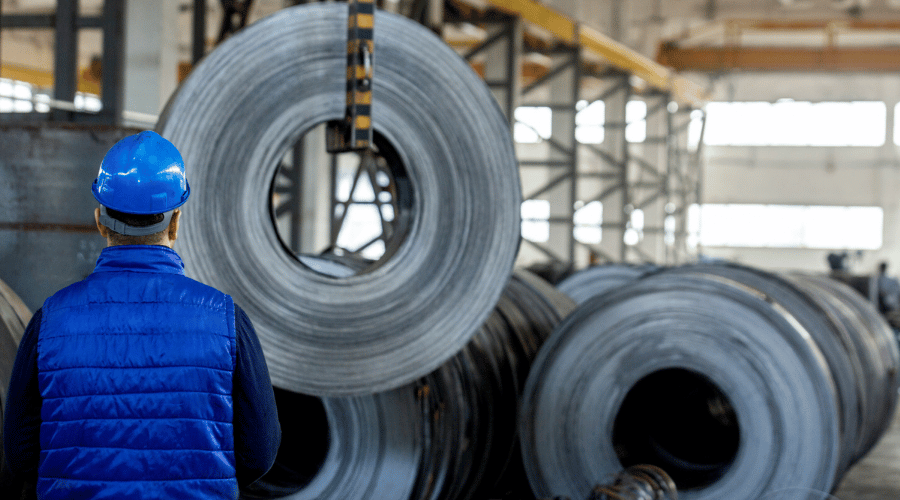
The electrical steel market covers specialty iron-silicon steels engineered to minimize energy losses in magnetic components. According to Expert Market Research, the global market reached about USD 49.77 billion in 2025 and is projected to reach nearly USD 99.75 billion by 2035, expanding at a 7.20% CAGR from 2026 to 2035.
Electrical steel, also called silicon steel or lamination steel, is fundamentally different from conventional structural steel because its value comes from its magnetic performance. High electrical resistivity, controlled grain structure, high permeability and low core loss allow manufacturers to build more efficient motors, transformers and generators. These properties make the material an important enabler of electrification rather than simply another steel product.
The market is consequently tied to several major structural trends: expanding electricity networks, renewable power generation, industrial automation, electric vehicles and the continuing push for higher energy efficiency. Every improvement in the magnetic efficiency of a motor or transformer can reduce energy consumption over years of operation, making relatively small material improvements commercially significant.
The market is generally divided into grain-oriented electrical steel (GOES) and non-grain-oriented electrical steel (NGOES). It is also segmented by applications such as transformers, motors and generators, with additional demand coming from appliances, inductors, industrial equipment and other electromagnetic devices.
Key Types and Performance Characteristics
The two principal types are grain-oriented electrical steel and non-grain-oriented electrical steel. GOES is optimized for magnetic flux flowing predominantly in one direction, whereas NGOES provides more uniform magnetic properties in different directions and is therefore better suited to rotating electrical machines.
Grain-oriented electrical steel is primarily associated with transformer cores. Its crystal grains are processed so that the preferred magnetic direction aligns closely with the rolling direction. This creates high permeability and very low iron loss along that direction, making GOES particularly valuable in power and distribution transformers. Advanced grades can further reduce losses through techniques such as magnetic-domain refinement.
Non-grain-oriented electrical steel, by contrast, is commonly used in motors and generators because magnetic flux changes direction as the rotor turns. The material must therefore perform effectively in multiple directions. Modern NGO grades are increasingly designed around demanding automotive and industrial requirements, where low losses, high strength and high power density must often be achieved simultaneously.
The distinction is becoming more commercially important as electrical-machine designs become smaller, faster and more efficient. For example, ArcelorMittal’s current electrical-steel portfolio includes specialized NGO grades for traction motors, including products designed around low magnetic losses, mechanical strength and high-speed rotor performance.
The Importance of Low Core Losses
Low core loss means less energy is dissipated as heat when a magnetic core is repeatedly magnetized and demagnetized. In a transformer or electric motor operating thousands of hours per year, even a modest reduction in losses can improve efficiency, lower operating costs and reduce associated emissions.
The commercial importance of this characteristic is increasing as energy systems become more electrified. Nippon Steel, for example, describes high-efficiency GO and NO electrical steels as materials that reduce energy losses in EV and hybrid-vehicle motors and in power-transmission and distribution transformers.
Major Applications Across the Electrical and Automotive Industries
Transformers remain a foundational application for electrical steel, while motors are becoming an increasingly important growth engine because of electric vehicles, industrial electrification and energy-efficient appliances. Generators and renewable-energy equipment provide another long-term source of demand.
Transformers and Grid Infrastructure
Transformers require magnetic cores that can transfer electrical energy efficiently between voltage levels. Grain-oriented electrical steel is particularly suited to this role because its directional magnetic properties support efficient flux movement through transformer cores.
Demand for transformers is being strengthened by grid modernization, new generation capacity, renewable-energy integration and growing electricity consumption. The expansion of data centers and other electricity-intensive facilities is also increasing the need for power infrastructure, creating another indirect demand channel for transformer-grade electrical steel.
For electrical-steel suppliers, transformer demand is attractive because high-performance grades can command greater technical value than standard steel products. Manufacturers therefore compete heavily on magnetic loss characteristics, consistency, thickness, coating performance and the ability to supply large volumes reliably.
Motors, Generators and Electric Vehicles
Motors represent the other major application. NGO electrical steel forms the magnetic core of stators and rotors in industrial motors, household appliances and vehicle traction systems. As motor efficiency becomes more important, manufacturers increasingly seek thinner and higher-performance grades that can reduce losses without compromising mechanical integrity.
Electric vehicles amplify this trend. A traction motor must deliver high power from a relatively compact package, so its electrical-steel core must balance magnetic efficiency with mechanical strength and high-speed performance. ArcelorMittal’s current e-mobility products, for example, are explicitly designed to help automakers develop compact, lightweight and power-dense traction motors.
Generators provide a third important demand channel, particularly in wind, hydro and conventional power generation. Electrical steel is also used in industrial drives, inductors, appliances and other electromagnetic equipment. This diversified application base gives the market structural resilience because demand is not dependent on a single end-use industry.
Growth Drivers Shaping the Market Through 2035
The strongest growth drivers are electrification, grid investment, electric-vehicle production, renewable-energy deployment and the rising economic value of energy efficiency. These forces increase both the volume of electrical machines being produced and the performance requirements placed on their magnetic cores.
The global transition toward electrification is particularly significant. More electricity generation requires generators and transformers; more transmission and distribution infrastructure requires transformers; and greater use of electricity in transportation and industry requires motors. Electrical steel sits within each of these interconnected value chains.
Electric vehicles are changing the product mix as well as the volume of demand. Conventional automotive production already uses electrical steel in numerous electrical components, but EV traction motors place greater emphasis on high-performance NGO grades. The industry is responding with thinner sheets, improved magnetic characteristics, stronger grades and specialized coatings.
Renewable energy creates another multiplier effect. Wind turbines require generators, while solar-heavy electricity systems require extensive transmission, distribution and storage infrastructure. As power networks accommodate more variable generation and greater electricity flows, efficient transformers and electrical machines become increasingly valuable.
Industrial efficiency is equally important. Motors account for a significant share of industrial electricity consumption, so improving motor efficiency has direct economic benefits. The push toward efficient pumps, compressors, fans, HVAC systems and automated machinery therefore supports long-term NGO electrical-steel demand.
Regional Market Landscape
Asia Pacific is the leading regional market, supported by its enormous manufacturing base, power infrastructure investment and concentration of automotive and electrical-equipment production. North America and Europe remain strategically important because of electrification, reshoring, renewable energy and demand for premium high-efficiency grades.
Asia Pacific has a particularly strong position across both major product categories. Grand View Research estimates that the region accounted for 66.2% of global non-grain-oriented electrical-steel revenue in 2024, while its grain-oriented segment represented about 69% of global GOES revenue that year.
China is central to the regional market because of its scale in steelmaking, electric motors, transformers, appliances, renewable energy and electric vehicles. Japan and South Korea add substantial technological capability, particularly in advanced electrical steels and high-efficiency automotive applications.
India is emerging as another important growth market. Rapid power-network expansion, industrialization, renewable-energy investment and vehicle electrification are increasing the need for electrical steel. The country’s NGO electrical-steel market alone was estimated at about USD 1.02 billion in 2025 and is forecast to reach approximately USD 1.62 billion by 2033, according to Grand View Research.
North America is seeing a strategic push toward localized electrical-steel supply. ArcelorMittal announced plans for a new Alabama NGO electrical-steel facility with potential annual capacity of up to 150,000 metric tons, aimed at automotive, renewable-power, motors and generators.
Europe remains an innovation-heavy market, particularly for premium NGO grades used in e-mobility and industrial drives. ArcelorMittal has expanded electrical-steel capacity in France and continues developing grades aimed at lower losses, higher strength and more compact electric motors.
Latin America and the Middle East and Africa are smaller markets but offer longer-term opportunities through grid expansion, industrialization, renewable-energy projects and increasing electricity access. Their growth is likely to be more closely tied to infrastructure investment than to premium automotive applications.
Competitive Landscape and Leading Companies
Competition is concentrated among technically capable steelmakers with specialized electrical-steel production, processing expertise and established relationships with transformer, motor and automotive customers. Product development, capacity expansion, quality consistency and regional supply are becoming as important as headline production volume.
The companies identified in the supplied market scope include ArcelorMittal S.A., China Baowu Steel Group Corp., Ltd., Nippon Steel Corporation, United States Steel Corporation, Steel Authority of India Limited (SAIL), and Tata Steel Limited. The supplied company name “State Authority of India Limited” is conventionally known as Steel Authority of India Limited.
Nippon Steel is particularly relevant because it offers both GO and NO electrical-steel sheets, including products for transformers, EVs, hybrid vehicles, appliances and industrial machines. The company’s acquisition of U. S. Steel was completed on June 18, 2025, making U. S. Steel a consolidated subsidiary of Nippon Steel and changing how the competitive landscape should be interpreted.
ArcelorMittal is pursuing a differentiated strategy around high-performance NGO electrical steels for e-mobility, industrial motors and renewable-energy equipment. Its recent investments in France and the United States indicate that regional production capacity is becoming strategically important as customers seek secure, technically qualified supply.
The competitive environment also includes major Asian producers and specialty-steel manufacturers whose strengths lie in scale, advanced processing and proximity to large electrical-equipment manufacturing clusters. In practice, customers are likely to qualify several suppliers but place significant value on technical consistency, certification, delivery reliability and the ability to develop grades jointly with equipment designers.
Market Challenges and Industry Constraints
The biggest challenges are production complexity, capital intensity, raw-material and energy costs, supply-chain concentration and the difficulty of simultaneously improving magnetic performance, mechanical properties and sustainability.
Electrical steel requires specialized manufacturing routes and tight process control. Producing thinner, lower-loss material can require significant investment in rolling, annealing, coating and finishing equipment. As customers demand higher performance, suppliers must spend continuously on research, process optimization and plant upgrades.
Supply constraints can also become important when demand rises quickly. Electrical infrastructure projects, EV manufacturing and renewable-energy deployment can increase demand for specific grades faster than new capacity can be commissioned. India’s recent investments illustrate this dynamic: JSW Steel and JFE Steel announced a joint investment of about INR 58.45 billion to expand cold-rolled grain-oriented electrical-steel capacity, with the planned expansion intended to increase output substantially from existing facilities.
Sustainability presents a more complicated challenge. Electrical steel helps customers reduce operational energy consumption, but manufacturing steel itself remains energy intensive. Consequently, producers increasingly need to demonstrate lower product carbon footprints while maintaining magnetic performance. Nippon Steel, for example, publishes carbon-footprint certifications for both grain-oriented and non-oriented electrical-steel products.
Another challenge is that EV growth does not automatically translate into uniform demand for every electrical-steel grade. Motor architectures, rotor speeds, power density targets and manufacturing methods differ considerably among vehicle platforms. Suppliers therefore need flexible portfolios rather than a single “EV steel” solution.
Future Outlook and Investment Opportunities
The electrical steel market is positioned for sustained expansion because its principal applications sit at the center of the global electrification economy. The supplied market forecast places global value at USD 49.77 billion in 2025 and nearly USD 99.75 billion in 2035, implying a 7.20% CAGR over 2026–2035.
The most important takeaway is that future growth will be increasingly quality-driven. Demand for transformers, motors and generators will raise overall volumes, but premium grades with lower core losses, higher permeability, greater strength and improved processing characteristics should capture disproportionate value.
For investors and industrial buyers, this means market analysis should go beyond headline tonnage. Capacity additions, regional self-sufficiency, EV motor specifications, transformer backlogs, renewable-energy investment and manufacturers’ ability to produce advanced grades are all important indicators of future performance.
For steel producers, the opportunity lies in moving further toward specialty electrical steels rather than competing only on commodity pricing. For equipment manufacturers, securing reliable supplies of qualified grades may become a strategic consideration as electrical-machine production expands.
Overall, electrical steel is becoming a critical enabling material for a more electrified economy. Its role in reducing losses inside transformers, motors and generators gives the market a durable structural driver, while EVs, renewable energy, grid modernization and industrial efficiency provide multiple avenues for expansion. The companies that combine advanced metallurgy, dependable capacity and close collaboration with equipment manufacturers are likely to be best positioned as the market approaches the next decade of growth.