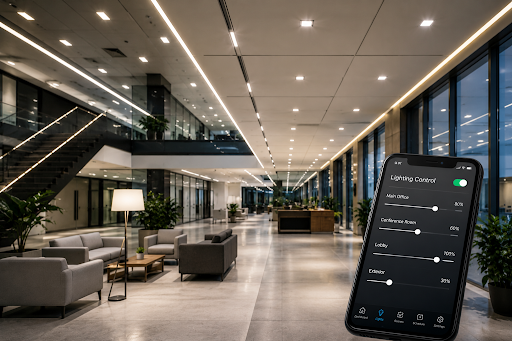
Smart commercial lighting makes use of LED lighting plus motion sensors, daylight harvesting, and scheduling to tie into a BMS through which it can be monitored and controlled. In this way, lights are turned on when needed, depending on the occupancy and daylight in a space, rather than running on a fixed schedule. It cuts costs and uses sensors to give facility managers a lighting layer they can control from their BMS.
What Is Smart Commercial Lighting?
Smart commercial lighting is a networked system where each fixture, or group of fixtures, can be sensed, dimmed, scheduled, and reported on individually rather than controlled by a single wall switch.
It usually involves LED luminaires, such as 3W LED architectural downlights, combined with sensors that measure occupancy, daylight, and a control system, which connects to the building’s BMS (Building Management System). This is why lighting is fused into the overall BMS, sharing information with HVAC or security.
How Much Can Smart Lighting Controls Reduce Energy Use?
Lighting is a huge part of commercial electricity use; hence, it provides major opportunities for control to reduce costs. According to the US Department of Energy’s (DOE) Energy Star Program, lighting takes 17% of the electricity in commercial buildings. The DOE’s Better Buildings Interior Lighting Campaign shows that participating organizations upgrading controls and lighting over 2.8 million light bulbs cut 54% of energy use on average, and $68 million in energy costs overall. In another case study, the DOE also found that building owners can save up to 80% of lighting energy specifically by adding controls such as dimmers, timers, and occupancy sensors on top of efficient fixtures.
These figures matter because they separate two savings sources: switching to LED fixtures, and adding controls on top of them. Upgrading fixtures alone can only capture part of the potential savings. The control system can capture the rest.
How Do Motion Sensors Act As A Building Automation System?
The occupancy sensor can recognize movements and activities of persons in a specific area and automatically shut off the electricity or dim the lights according to the received data. In a smart building, these sensors allow not only managing the light source but also providing information on occupancy to the BMS to enable further analysis at the level of zones and floors. This is especially effective in spaces with irregular use, such as conference rooms, storage areas, and restrooms.
| Component | Function | Typical Building Role |
| 3W LED downlight | Efficient light source | Offices, corridors, retail |
| Occupancy sensor | Detects presence/absence | Triggers dim/off states |
| Daylight sensor | Measures ambient light | Reduces output near windows |
| BMS integration | Central monitoring & control | Reporting, scheduling, alerts |
How Does A Building Management System Tie Lighting Together?
A BMS is the software that enables facility managers to control and monitor all lighting, HVAC, and other systems from a central interface rather than being on the ground floor. Lighting systems connected to the BMS allow managers to set schedules for the whole building, receive alerts about malfunctioning lights, and review consumption reports sorted by zones. Furthermore, connected lighting systems provide reporting capability needed to verify Energy Star standards and sustainability certifications for the building.
Conclusion
Smart commercial lighting solutions require close coordination between the fixture, sensor layer, and BMS to maximize performance. This is exactly what CIRC Lighting delivers by specifying LED downlights, 3W architectural downlights, and control layers with built-in BMS compatibility to ensure turnkey efficiency. This integrated approach lets building owners install a truly intelligent lighting system that is intuitive to manage and maintain long-term.