Learning to drive is an important milestone that offers greater independence, flexibility, and convenience. However, choosing the right driving instructor can make a significant difference to how confidently and efficiently a learner develops their driving skills. For people who prefer automatic vehicles, finding professional instruction that combines affordability, experience, and effective teaching is particularly important.
Automatic cars are becoming increasingly popular among learner drivers in the UK. Without the need to operate a clutch or change gears manually, learners can concentrate more fully on steering, road positioning, traffic awareness, and hazard perception. This makes automatic driving lessons an attractive option for beginners, nervous drivers, and people who want a straightforward learning experience.
In Lancashire, learners have access to different driving schools and instructors offering automatic tuition. Understanding what makes an instructor suitable, how to compare lesson costs, and what to expect during training can help learners make informed decisions.
Why Are Automatic Driving Lessons Becoming More Popular?
Automatic vehicles have become a practical choice for many modern drivers. Improvements in vehicle technology, the growth of hybrid and electric cars, and changing driving preferences have contributed to increased interest in automatic transmission.
Unlike manual vehicles, automatic cars manage gear changes without requiring the driver to operate a clutch pedal. This removes one of the initial challenges that beginners often experience.
Some important advantages include:
- Simpler vehicle control: Learners do not need to coordinate clutch movements and gear changes.
- Greater concentration: More attention can be directed towards traffic conditions, road signs, pedestrians, and potential hazards.
- Reduced initial pressure: Beginners can focus on understanding road rules and developing safe driving habits.
- Suitable for nervous learners: Fewer vehicle controls may help reduce anxiety during early lessons.
- Useful for modern vehicles: Automatic transmission is common in many hybrid and electric cars.
However, automatic driving still requires strong observation, anticipation, decision-making, and vehicle-control skills. Learning in an automatic vehicle does not remove the responsibility of understanding road safety.
How to Choose the Best Affordable Automatic Driving Instructor
Finding the Best Affordable automatic driving instructor involves more than comparing hourly lesson prices. A suitable instructor should provide structured training, clear explanations, patience, and guidance that matches the learner’s individual abilities.
Here are several factors worth considering before choosing a driving instructor.
1. Check Instructor Qualifications and Experience
Professional standards are essential when selecting driving tuition. In Great Britain, Approved Driving Instructors (ADIs) are registered with the Driver and Vehicle Standards Agency (DVSA). Potential Driving Instructors (PDIs) may also provide lessons while completing the required qualification process, subject to applicable rules.
Learners should check an instructor’s registration and understand their experience with automatic tuition.
An experienced instructor should be able to:
- Explain driving techniques in straightforward language.
- Identify mistakes and provide constructive feedback.
- Adapt lessons to different learning speeds.
- Teach safe responses to changing road conditions.
- Prepare learners for the practical driving test.
Experience with nervous beginners can also be valuable, particularly for people who have never driven before.
2. Compare Lesson Prices and Overall Value
Affordability is an important consideration, especially for students, young professionals, and people managing regular household expenses.
However, the cheapest lesson is not necessarily the best option. Learners should consider what is included in the price and whether the instructor offers consistent, high-quality teaching.
Before booking, ask about:
- Standard hourly lesson rates.
- Block-booking arrangements.
- Lesson duration and frequency.
- Cancellation and rescheduling policies.
- Any additional test-day arrangements.
- Whether the instructor uses a suitable dual-control automatic vehicle.
Comparing these details provides a clearer understanding of the overall cost of learning.
A good instructor should also be transparent about pricing rather than making unrealistic promises about guaranteed test passes or unusually short learning periods.
3. Look for Patience and Effective Communication
Every learner progresses differently. Some people understand vehicle controls quickly, while others need additional time to develop confidence with junctions, roundabouts, parking, and busy roads.
A patient instructor creates an environment where learners can ask questions, recognise mistakes, and improve without unnecessary pressure.
Effective communication is especially important during the early stages of learning. Instructions should be clear, timely, and easy to understand.
What Should Beginners Expect from Automatic Driving Lessons?
Automatic driving lessons for beginners usually follow a structured learning process. The instructor gradually introduces different driving skills, allowing learners to build confidence before attempting more challenging situations.
Although lesson structures vary, most beginners can expect to develop the following abilities.
Stage 1: Understanding Vehicle Controls
The first lessons generally introduce the essential controls of an automatic vehicle.
Learners become familiar with:
- Accelerator and brake pedals.
- Gear selector positions, including Park, Reverse, Neutral, and Drive.
- Steering and indicators.
- Mirrors and blind spots.
- Starting and stopping procedures.
- Seat, head restraint, and mirror adjustments.
Understanding these controls helps beginners feel more comfortable before driving in busier environments.
Stage 2: Developing Basic Driving Skills
Once learners understand the vehicle, they begin practising controlled movement on suitable roads.
Important skills include maintaining a safe speed, steering accurately, stopping smoothly, checking mirrors, and responding to road signs.
Instructors may introduce quieter residential streets before gradually moving towards more complex traffic conditions.
Stage 3: Learning Road Awareness and Manoeuvres
Road awareness is one of the most important parts of becoming a responsible driver.
Beginners need to understand how to approach junctions, identify hazards, judge gaps in traffic, and maintain suitable following distances.
Practical manoeuvres may include:
- Parallel parking.
- Reverse parking into a bay.
- Pulling up on the right and reversing.
- Safe positioning at junctions.
- Negotiating roundabouts.
- Meeting and passing other vehicles.
Regular practice helps learners improve accuracy and develop safer driving habits.

Stage 4: Preparing for the Practical Driving Test
As learners become more confident, lessons increasingly focus on independent driving and test preparation.
The UK practical driving test assesses several areas, including vehicle control, observation, manoeuvres, independent driving, and the ability to respond safely to different traffic situations.
Learners should also understand common driving faults and how to correct them.
A mock driving test can help identify areas that require additional practice before the actual examination.
Common Challenges Faced by Automatic Learners and How to Overcome Them
Although automatic vehicles simplify certain aspects of driving, beginners can still encounter challenges. Recognising these difficulties early helps learners improve more effectively.
Nervousness in busy traffic
Some learners feel uncomfortable when driving around unfamiliar vehicles, pedestrians, or busy junctions.
The solution is gradual exposure. Start with quieter roads and increase the difficulty of driving situations as confidence develops.
Difficulty judging speed and distance
Maintaining an appropriate speed and understanding stopping distances can take practice.
Learners should follow their instructor’s guidance, observe road conditions carefully, and avoid making sudden decisions.
Lack of confidence at roundabouts
Roundabouts require observation, correct positioning, signalling, and appropriate judgement.
Practising different types of roundabouts under instructor supervision can help learners understand traffic flow and make safer decisions.
Struggling with parking manoeuvres
Parking requires good observation, steering control, and an understanding of vehicle positioning.
Breaking each manoeuvre into smaller steps makes it easier to learn and repeat consistently.
Inconsistent practice
Long gaps between lessons can make it harder to retain previously learned skills.
Where possible, learners should arrange lessons at regular intervals and review feedback after each session.
Why Local Knowledge Matters When Learning to Drive in Lancashire
Learning with an instructor familiar with Lancashire roads can provide useful practical experience. Different areas present different driving challenges, from residential streets and narrow roads to busy town centres, roundabouts, and faster routes.
Learners should gradually gain experience in different environments rather than becoming comfortable with only one familiar route.
Local driving practice may involve:
- Navigating residential roads and parked vehicles.
- Approaching busy junctions safely.
- Understanding local speed limits.
- Managing traffic in town centres.
- Driving in different weather and visibility conditions.
- Developing confidence on unfamiliar roads.
For example, learners taking lessons in Blackburn, Preston, Accrington, Darwen, and surrounding Lancashire communities may encounter different traffic patterns and road layouts.
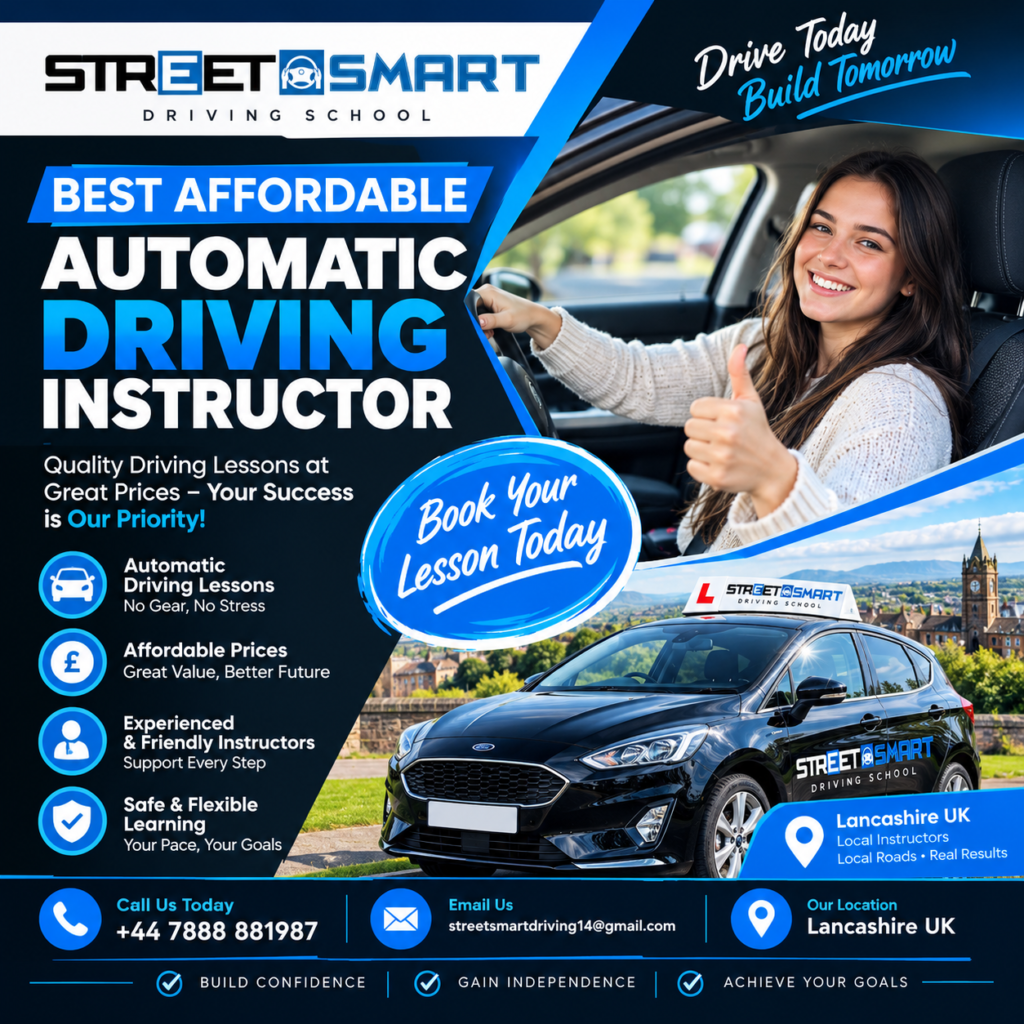
Street Smart Driving School is one example of a local driving school serving learners in Lancashire. When comparing local providers, learners can consider factors such as automatic tuition availability, instructor experience, lesson arrangements, and suitability for beginners.
The most important consideration is finding an instructor who can deliver safe, structured, and supportive training.
Practical Tips for Getting More Value from Every Driving Lesson
Learning to drive involves both practical experience and continuous improvement. A few simple habits can help learners make better use of their lesson time.
Set clear learning goals: Discuss what you want to improve before each lesson, whether it is roundabouts, parking, or independent driving.
Listen to instructor feedback: Constructive feedback helps identify mistakes before they become repeated habits.
Ask questions: If an instruction or manoeuvre is unclear, ask the instructor to explain it again.
Practise hazard awareness: Pay attention to pedestrians, cyclists, road signs, parked vehicles, and changing traffic conditions.
Maintain a learning record: Write down the skills covered and areas requiring further practice.
Avoid rushing the process: The number of lessons required depends on individual ability, previous experience, confidence, and practice opportunities.
It is also important to remember that automatic driving licences in Great Britain normally restrict the holder to driving automatic vehicles. Learners who later want to drive manual cars will generally need to pass a separate manual practical driving test.
Conclusion
Choosing the right automatic driving instructor is an important step towards becoming a confident and responsible driver. Affordability matters, but it should be considered alongside teaching quality, professional standards, communication, and lesson structure.
For beginners, automatic tuition offers a practical way to learn essential driving skills without the additional challenge of manual gear changes. By comparing instructors carefully, attending regular lessons, practising different road situations, and acting on professional feedback, learners can develop the knowledge and confidence needed for independent driving.
Read More: