Learning to drive is an important milestone that offers greater independence, flexibility, and convenience in everyday life. However, choosing the right type of driving lessons can make a significant difference to the learning experience. For many beginners, automatic vehicles provide a straightforward way to develop essential driving skills without the additional challenge of operating a manual gearbox. As a result, automatic driving lessons Bolton have become an appealing option for learners who want to concentrate on road awareness, vehicle control, and safe driving habits.
Bolton offers a variety of driving environments, from busy town-centre roads and residential streets to roundabouts, junctions, and faster routes connecting nearby communities. Learning to manage these different conditions requires patience, consistent practice, and suitable instruction. Understanding how automatic driving works, what to expect from lessons, and how to prepare for the practical test can help learners make informed decisions throughout their driving journey.
1. Why Are Automatic Driving Lessons Becoming More Popular?
Automatic cars are increasingly common on UK roads. Modern vehicle technology, hybrid systems, and electric vehicles have contributed to growing interest in automatic transmission. Unlike manual cars, automatic vehicles do not require learners to operate a clutch pedal or manually change gears while driving.
This can make the initial learning process less complicated, particularly for people who find coordinating multiple controls challenging.
Some important advantages include:
- Simpler vehicle operation: Learners can concentrate on steering, braking, acceleration, and road positioning.
- Reduced coordination demands: Without clutch control and manual gear changes, beginners have fewer controls to manage simultaneously.
- Greater focus on road awareness: Learners can dedicate more attention to traffic signs, pedestrians, cyclists, and other road users.
- Useful for urban driving: Automatic transmission can make repeated stopping and starting in busy traffic more manageable.
- Suitable for different learners: People returning to driving, nervous beginners, and those who prefer simpler vehicle controls may find automatic lessons beneficial.
However, automatic driving still requires strong observation, decision-making, and vehicle-control skills. Simpler transmission does not remove the responsibility of driving safely.
2. Choosing the Right Automatic Driving Instructor in Bolton
The quality of driving instruction plays an important role in how confidently a learner progresses. Finding a suitable automatic driving instructor Bolton learners can communicate with comfortably is therefore an important part of the process.
A professional instructor should understand the needs of beginners and adapt lessons according to individual progress. Some learners develop confidence quickly, while others need additional time to understand junctions, roundabouts, parking manoeuvres, and independent driving.
When comparing instructors, consider the following factors:
DVSA registration and qualifications
Check that the instructor is an Approved Driving Instructor (ADI) registered with the Driver and Vehicle Standards Agency (DVSA), or is a qualifying Potential Driving Instructor (PDI) displaying the appropriate licence.
Teaching approach
An effective instructor should explain driving techniques clearly, demonstrate manoeuvres where necessary, and provide constructive feedback after each lesson.
Local road knowledge
Familiarity with Bolton’s road network can help learners practise different driving conditions, including busy junctions, residential areas, traffic-controlled crossings, and roundabouts.
Lesson structure
Lessons should have clear learning objectives. Rather than repeating familiar routes without purpose, instructors should gradually introduce new challenges as learners become more capable.
Communication and patience
A supportive learning environment makes it easier to ask questions, recognise mistakes, and improve without unnecessary pressure.
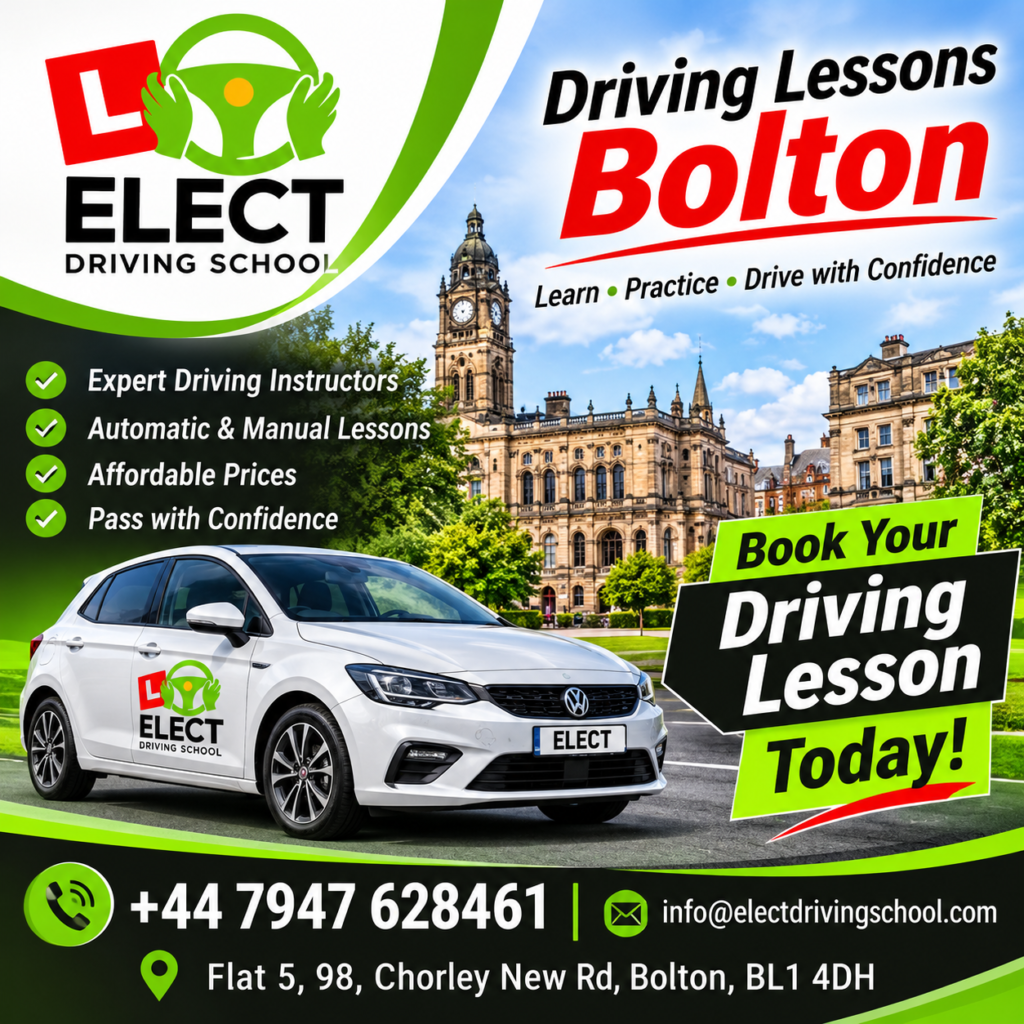
Providers such as Elect Driving School, based at Flat 5, 98, Chorley New Rd, Bolton, BL1 4DH, are an example of local driving-school options learners may consider when researching automatic driving instruction.
3. Essential Skills to Develop During Automatic Driving Lessons
Although automatic vehicles simplify gear operation, learners must still develop a wide range of practical driving skills before becoming safe and independent drivers.
A structured learning programme should cover the following areas.
Understanding vehicle controls
Before driving on public roads, learners should become familiar with the accelerator, brake pedal, steering wheel, indicators, mirrors, and automatic gear selector.
Most automatic vehicles use the following settings:
- P (Park): Used when the vehicle is parked.
- R (Reverse): Used for reversing.
- N (Neutral): Disconnects the drive from the wheels.
- D (Drive): Used for normal forward movement.
Learners should understand when and how to select each setting safely, following the vehicle manufacturer’s instructions.
Developing observation skills
Good observation is essential for preventing accidents. Learners should practise checking mirrors regularly, identifying hazards early, and understanding the actions of other road users.
The Mirror-Signal-Manoeuvre (MSM) routine is particularly useful when changing direction, moving around parked vehicles, or approaching junctions.
Navigating junctions and roundabouts
Bolton’s varied road network provides opportunities to develop confidence in different traffic situations. Learners should understand priorities, appropriate lane positioning, signalling, speed management, and safe gaps in traffic.
Roundabouts can initially feel challenging, but regular practice helps learners recognise road markings, choose suitable lanes, and make decisions confidently.
Parking and low-speed manoeuvres
Parking is another important part of driver training. Learners should practise:
- Parallel parking.
- Reversing into a parking space.
- Driving forward into a parking space.
- Pulling up safely on the left.
- Reversing safely when appropriate.
These skills are valuable for everyday driving as well as the practical test.

4. Common Challenges for Automatic Learners and How to Overcome Them
Every learner experiences difficulties at different stages. Recognising common challenges can make the learning process more manageable.
Nervousness in busy traffic
New drivers may feel uncomfortable when surrounded by vehicles, especially on unfamiliar roads. Starting with quieter routes and gradually progressing to busier areas can help build confidence.
Difficulty judging gaps
Joining traffic, emerging from side roads, and navigating roundabouts require accurate judgement. Learners should practise observing vehicle speed and distance rather than rushing decisions.
Maintaining appropriate speed
Driving too quickly or too slowly can create risks. Learners should understand speed limits, road conditions, visibility, and traffic flow before choosing an appropriate speed.
Overdependence on instructor guidance
Some learners become comfortable following instructions but struggle when making independent decisions. Gradually introducing independent driving exercises can help develop confidence and decision-making ability.
Making repeated mistakes
Mistakes are a normal part of learning. Rather than becoming discouraged, learners should understand why something went wrong and practise the correct technique during subsequent lessons.
Keeping a simple progress record can be useful. After each lesson, write down two things that went well and one skill that needs more attention.
5. Preparing for the UK Automatic Driving Test
Passing the practical driving test requires more than knowing how to operate an automatic vehicle. Candidates must demonstrate that they can drive safely, independently, and responsibly in different road conditions.
The UK practical test generally includes:
- An eyesight check.
- Vehicle safety questions, commonly called the ‘show me, tell me’ questions.
- Independent driving, which normally lasts around 20 minutes.
- General driving ability.
- One reversing manoeuvre.
- An emergency stop in some tests.
Candidates must demonstrate appropriate observation, control, positioning, judgement, and awareness throughout the assessment.
Practical preparation tips
Practise consistently: Regular lessons help reinforce techniques and reduce the time between learning and applying new skills.
Understand the Highway Code: Knowledge of road signs, markings, priorities, speed limits, and driving responsibilities is essential.
Experience different conditions: Practise in suitable daylight, different traffic conditions, and unfamiliar areas with instructor guidance.
Learn from mock tests: Mock assessments help identify weaknesses before the actual examination.
Avoid rushing the test date: Booking a practical test should depend on readiness rather than pressure from friends, family, or other learners.
One important consideration is the driving licence restriction. Passing the practical test in an automatic car generally means the resulting licence permits driving automatic vehicles only. Drivers who want to drive manual cars must pass a separate manual practical test.
6. The Future of Automatic Driving in Bolton
The popularity of automatic vehicles is closely connected to wider developments in the automotive industry. Hybrid and fully electric vehicles are becoming increasingly visible in the UK, and these vehicles generally use automatic-style driving controls.
This transition is influencing how people think about learning to drive.
For new drivers, automatic instruction can provide relevant experience for operating many modern vehicles. It may also help learners develop skills that remain valuable as vehicle technology changes.
However, future driving will still depend on the same fundamental principles: responsible decision-making, hazard awareness, patience, and consideration for other road users.
For Bolton residents, developing these skills can support safer journeys across local roads, neighbouring towns, and longer-distance routes.
Conclusion
Learning to drive an automatic vehicle can be a practical choice for people who want to simplify vehicle operation and concentrate on developing safe driving habits. From understanding basic controls to navigating roundabouts and preparing for the practical examination, every stage contributes to becoming a confident and responsible driver.
Choosing a qualified instructor, practising consistently, understanding the Highway Code, and learning from mistakes are essential steps towards progress. Whether someone is a complete beginner or returning to driving after a break, well-structured instruction can make the experience more manageable.
Ultimately, automatic driving lessons Bolton learners choose should provide more than preparation for passing a test. They should help develop the awareness, judgement, and confidence needed for a lifetime of safer driving.
Read More: